
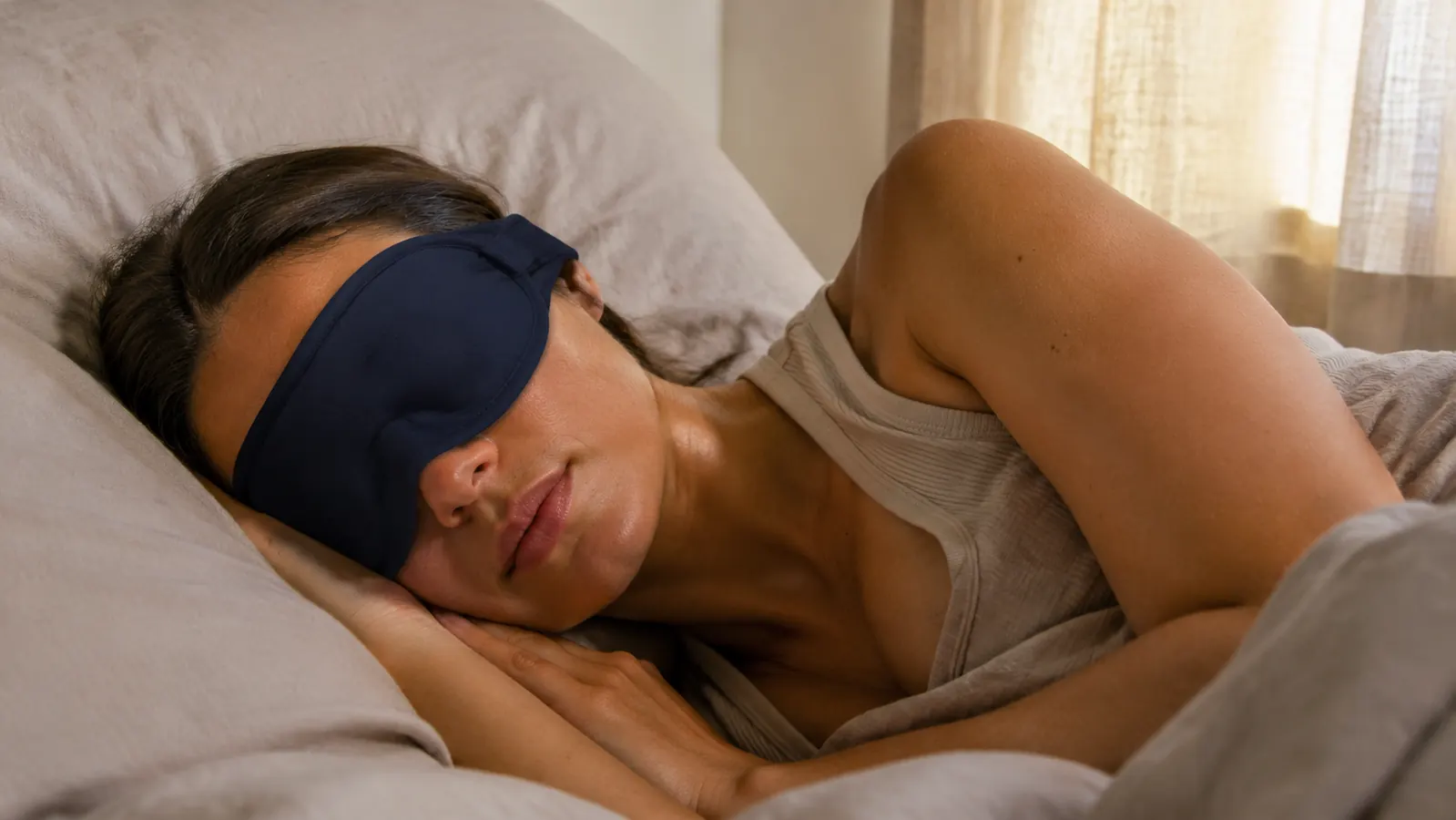
I am a light sleeper. Have been my whole life. I wake up when my cat jumps off the bed, when a car turns onto our street, when the sky starts to shift from black to deep blue at around 5:15 in the morning. My husband can sleep through anything. I have spent years being a little jealous of him. After six weeks wearing the MyHalos 3D blackout sleep mask every single night, I want to tell you exactly what changed, what did not change, and the one thing I wish someone had mentioned before I ordered it.
I am a physical therapist by training, which means I pay attention to how things fit the body. I think about pressure, contact points, and what happens over hours, not just minutes. That lens shapes how I evaluate sleep gear. Most sleep masks I had tried before this one were flat foam pads that pressed directly onto my eyelids and either let in light at the nose bridge or slid off by 2 a.m. The MyHalos is built differently, and that difference is real. But it also has a quirk that matters if you sleep on your side.
The Quick Verdict
Genuinely impressive light blocking and zero eyelid pressure. The side-sleeper fit takes a few nights to dial in, but once it does, this is the mask I reach for every night.
Amazon Check Today's Price →Still waking up when the sky lightens? This is the mask that actually seals.
The MyHalos 3D blackout mask has a contoured shell that floats over your eyelids instead of pressing on them. Over 21,000 reviewers. Budget-priced.
Amazon Check Today's Price on Amazon →How I've Used It
I ordered the MyHalos in early May and started wearing it that first night. My bedroom is not completely dark. We have a streetlight that comes through our curtains and our bedroom door lets in light from the hallway when my husband is still up. Those two sources were enough to pull me out of sleep in the early morning hours before I started using a mask. I wore the MyHalos every night for six weeks straight without skipping. I tracked how I felt in the mornings using a simple 1-to-10 scale I write in my paper journal, a habit I carry over from my clinical work where we ask patients to track symptoms the same way.
I am also a side sleeper, almost exclusively. I switch between my right side and my left, and I start most nights on my right. That detail matters for this mask more than I expected, and I will get into it. My husband also tried it for three nights during week two, so I have his input from a back-sleeper perspective as well.
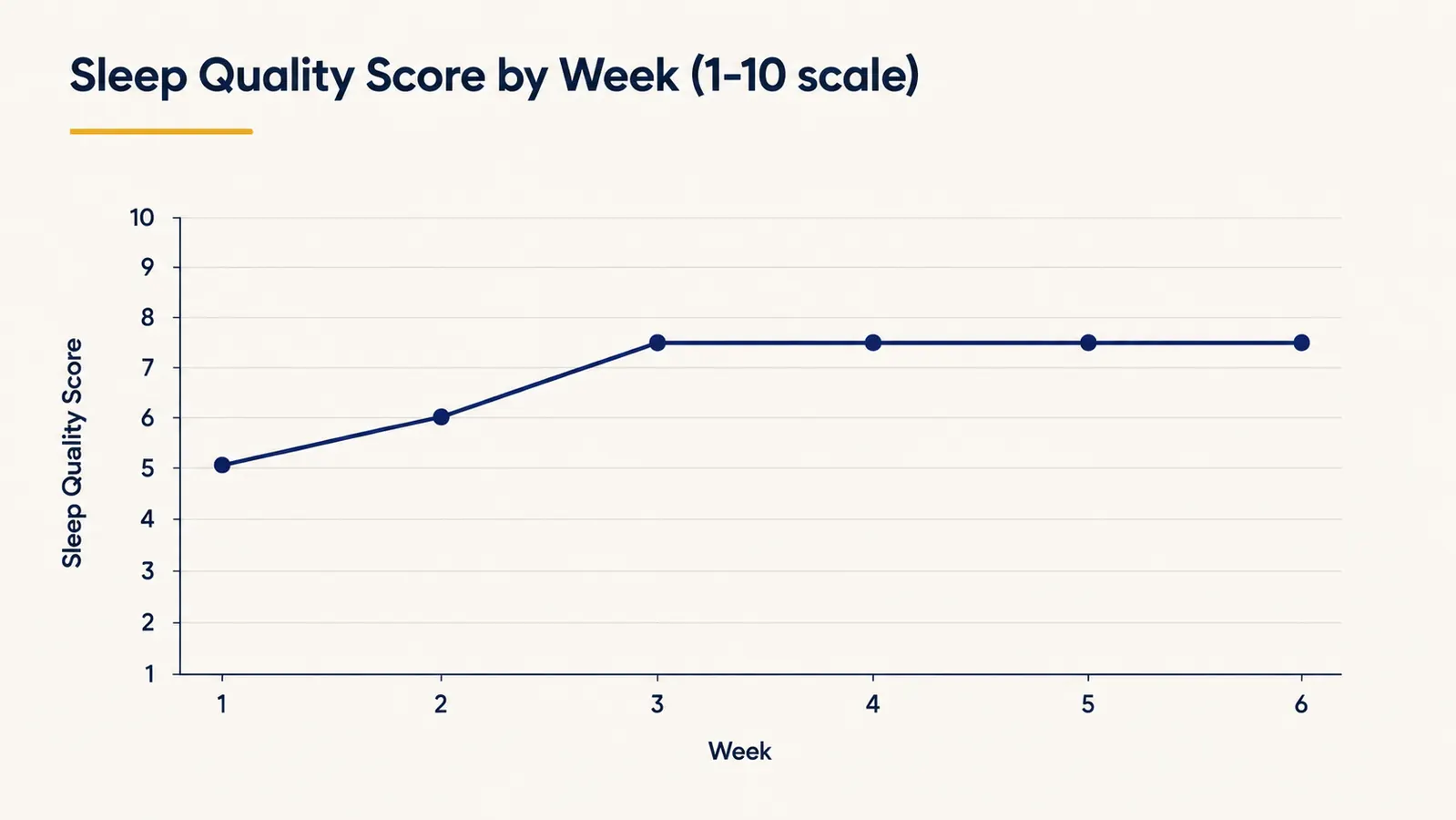
What changed over the six weeks: the first few nights I was aware of the mask. By week two I was not. By week three my morning journal scores had climbed from a 5 to a consistent 7.5. That plateau held. I did not wake up chasing the light anymore. I did not reach over to rub my eyes the way I had with flat masks that pressed on my corneas all night.
The Blackout Performance, Honestly Assessed
The 3D shell design is the whole point of this mask, and it delivers on that point better than anything else I have tried at this price. The rigid molded cups create a small dark chamber around each eye. Light does not filter through the fabric the way it does with a thin flat mask, because you are not looking at the fabric from two centimeters away. You are looking into a small dome of darkness.
The weakest point for light leakage is the nose bridge. On my face, the gap there lets in a very thin sliver of light when I am lying on my back. When I am on my side, that gap essentially disappears because the mask conforms slightly to the pillow. This is actually one of the few cases where being a side sleeper helps rather than hurts. My husband noticed more nose-bridge leakage than I did, purely because of sleep position.
The streetlight that used to pull me out of sleep at 5 a.m. is now simply gone. The hallway light is gone. When our smoke detector battery beeped at 4 a.m. one night and my husband got up to deal with it, he turned on the hallway light and I slept through it. That was the clearest test I could have run. The blackout quality is the real thing.
When our smoke detector beeped at 4 a.m. and my husband turned on the hallway light, I slept through it. That was the clearest test I could have run.
The Side-Sleeper Fit: Where It Gets Complicated
Here is the thing nobody mentions in the short reviews. The 3D shell adds about a centimeter of depth in front of your eyes. On your back, that does not matter at all. When you roll onto your side and your face meets the pillow, the edge of the shell pushes back against your cheekbone. Not painfully, but noticeably. The first two nights I woke up once each night adjusting the mask because the shell had pressed at an awkward angle.
By night five I had figured out my adjustment. I position the mask slightly higher on my forehead before I turn onto my side so the shell clears my cheekbone. This takes about three seconds and becomes automatic. My recommendation: sleep on your back for the first few minutes until you drift off if you can, then roll. If you are a strict side sleeper who rolls immediately and stays there, plan for a two-to-four night adjustment period while you find your angle. It is solvable. It is just not instant.
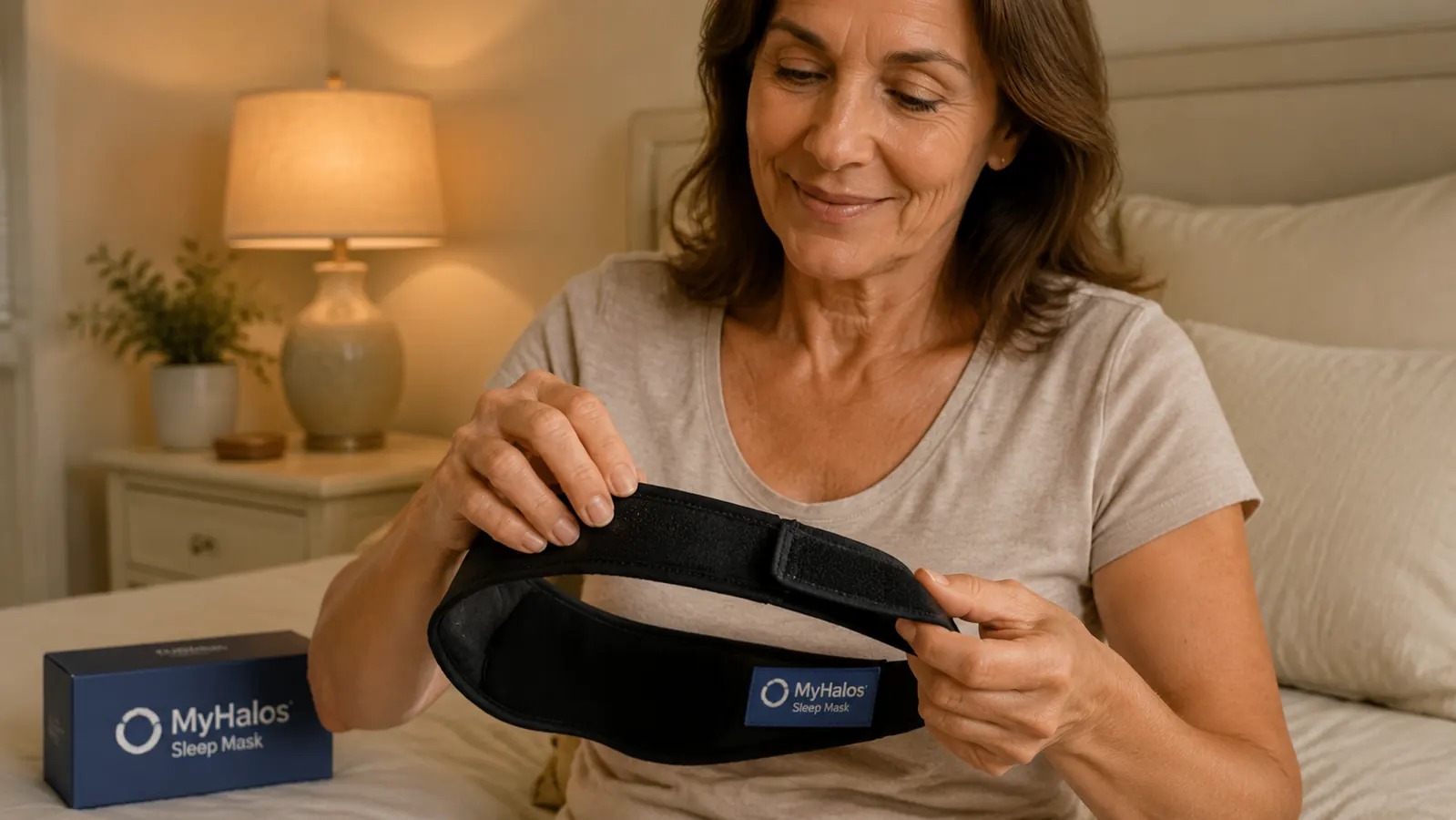
The strap is wide and adjustable via velcro, which is gentler on hair than elastic. I have medium-length hair and I did not get the tangled, crimped strap problem I have had with elastic masks. My husband, who has very short hair, said the strap felt natural from the first night. After six weeks the velcro still grips the same as the first night. No degradation.
Eye Pressure and Sleep Quality Over Time
As a PT I take the no-eye-pressure claim seriously. Flat masks press on the eye surface all night. That contact disrupts REM sleep in some people, and in a small subset it can affect intraocular pressure over time. The 3D shell of the MyHalos floats over the eye rather than resting on it. My eyelashes do not touch the mask when my eyes are closed. I can blink freely inside the cup if I happen to open my eyes at night. That freedom matters more than you might expect. It is the difference between feeling held versus feeling compressed.
My morning journal scores tell the clearest story. Week one averaged 5.1. Week two averaged 6.7. Weeks three through six held at 7.4 to 7.8. I was not doing anything else differently during this period. Same sleep time, same room temperature, same cat on the bed. The variable that changed was the mask. I am careful about drawing causal conclusions from personal data, but a two-point sustained improvement across four weeks is not noise.
I also stopped having that specific kind of early-morning half-wakefulness where you are aware the room is brightening and you keep drifting in and out. That shallow tail end of sleep had been costing me roughly 45 minutes of rest on most mornings. It is not costing me that anymore.
What Falls Short
The nose bridge seal is not perfect, especially for back sleepers or people with lower nose bridges. If you have a narrower face, you may find that the mask gaps more than it does for me. The light leakage there is thin, but it is real under bright conditions. A few readers I know with narrow faces have mentioned using a small piece of soft foam at the nose bridge. That is a workable fix but it should not be necessary on a product that otherwise fits well.
The mask is not designed for hot sleepers. The shell creates a closed microenvironment around each eye, and if you run warm at night, you may notice that area feeling slightly stuffy. I am a normal-temperature sleeper so this was not an issue for me, but on two particularly warm nights I did notice more warmth around my eyes than usual. If you sleep hot and kick off covers regularly, pay attention to that.
Washing it requires care. The shell is rigid and the velcro is aggressive. I hand-wash mine in cool water with gentle soap and lay it flat. Do not put it in the dryer. The instructions say the same. This is not a complaint exactly, just something to know going in. It takes about 30 minutes to fully dry, so if you forget to wash it in the morning you may be waiting on it that evening.
What I Liked
- Genuine total-darkness blackout that holds up under real light sources, not just ambient light
- Zero eyelid or eyelash pressure from the contoured 3D shell design
- Wide velcro strap does not tangle or crimp hair the way elastic does
- Velcro grip stays strong after six weeks of nightly use and regular washing
- Light enough to forget you are wearing it once you adjust, roughly by night five or six
- Budget-friendly, which makes it one of the most cost-effective sleep improvements available
Where It Falls Short
- The 3D shell adds depth that side sleepers must consciously position for the first few nights
- Nose bridge seal is imperfect, especially for narrow faces or back sleepers under bright light
- Slightly warmer microenvironment around the eyes, noticeable for people who already sleep hot
- Hand-wash only, and the 30-minute dry time means you need to plan around washing
How It Compares to What I Tried Before
Before the MyHalos, I went through three other sleep masks over about four years. A basic flat foam mask that pressed on my eyes and lost its elastic within three months. A silk flat mask that felt lovely but slipped off by 3 a.m. every time. And a slightly pricier 3D mask from a different brand that fit my back-sleeping husband better than it fit my side-sleeping face. The MyHalos has held up better than any of them at a lower price than two of the three. If you want a full head-to-head comparison between 3D and flat mask designs, I covered that in detail in my piece on 3D sleep masks versus flat eye masks for side sleepers.
The thing that separates the MyHalos from the other 3D options I tried is the strap system. The velcro strap is wide enough to distribute pressure across the back of your head and it does not dig in the way a thin elastic strap does after a few hours. After six weeks I have no marks on my head when I take it off in the morning. That was not the case with the previous 3D option I tried, which left a faint crease across the back of my scalp.
Who This Is For
If you are a light sleeper whose main problem is light, whether that is an early sunrise, a streetlight, a partner who reads in bed, or a hallway that stays lit, this mask addresses that problem directly and at a price that makes it nearly a no-risk purchase. If you are a side sleeper, you will need about five nights to find your positioning with the shell, but that learning curve is real and manageable, not a dealbreaker. If you travel frequently, it packs flat enough for a carry-on and works just as well in a hotel room as it does at home. And if you have ever had a flat mask press on your eyes uncomfortably all night, the 3D design will feel like a meaningful upgrade from the first morning you wake up without that groggy, eye-rubbing feeling. If you want to understand more about why the 3D shell design blocks light more completely than flat alternatives, I wrote a piece specifically on why contoured sleep masks block more light than flat eye masks that goes into the mechanics in plain terms.
Who Should Skip It
If you sleep hot and you already notice warmth around your eyes or face at night, the enclosed shell may add to that discomfort. If you have a very narrow face and need a perfect seal at the nose bridge, you may find the gap there frustrating enough to outweigh the benefits. And if you need a mask you can throw in a washing machine and forget about, this is not that mask. For those needs, a simpler flat silk mask or one with a silicone nose seal might serve you better.
Six weeks in, this is still the mask on my nightstand.
The MyHalos 3D blackout mask is budget-priced with over 21,000 reviews. If early light is costing you sleep, it is worth finding out if it works for your face shape. The price makes that a low-stakes experiment.
Amazon Check Today's Price on Amazon →