
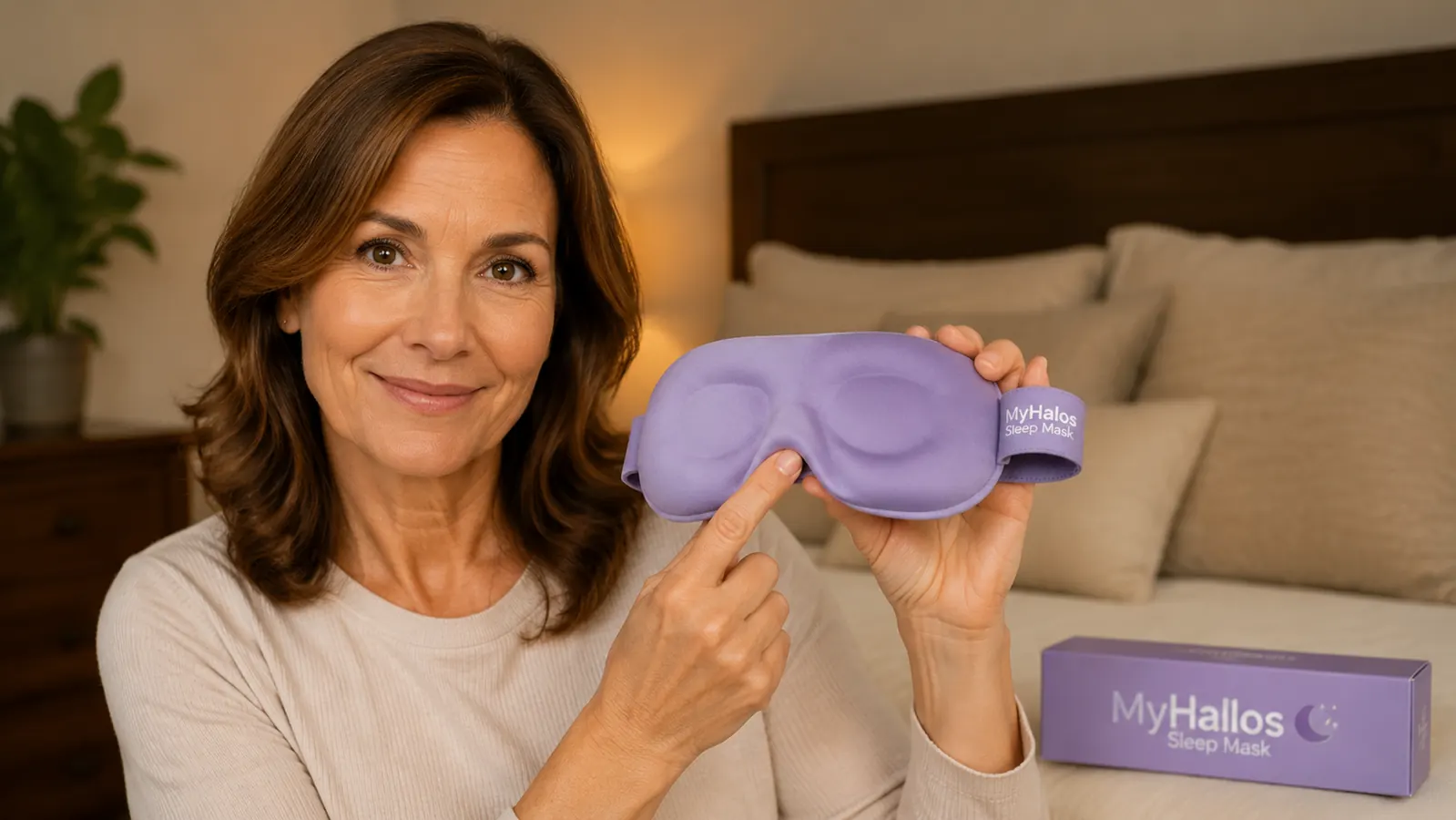
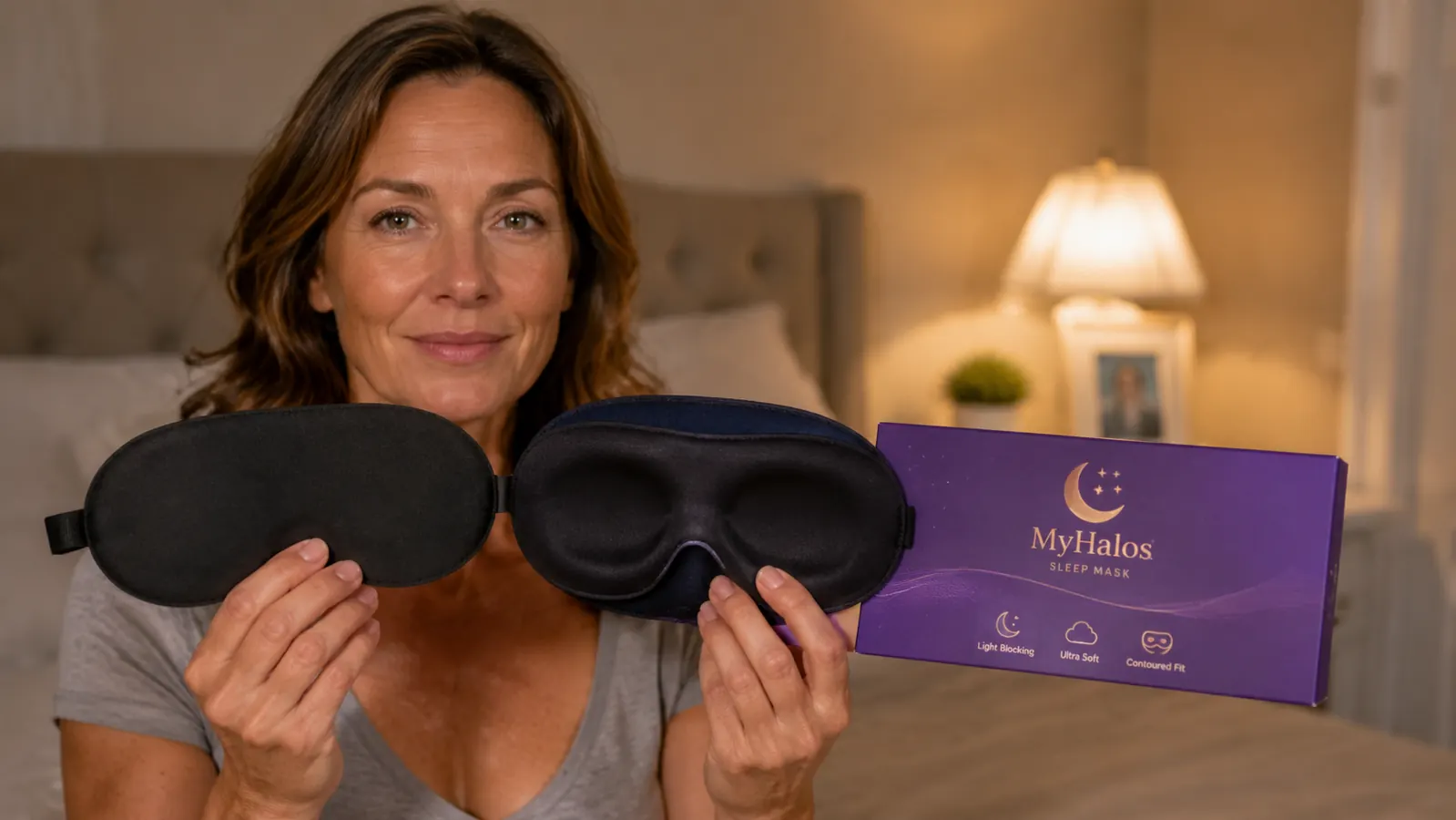
I have worked as a physical therapist for fourteen years. Every week I hear the same complaint wrapped in different words: I cannot stay asleep. Sometimes it is pain. Often it is light. The sky starts brightening at 5 a.m. in the summer and the body wakes up before the person is ready. When patients ask me about sleep accessories I try to give them the kind of honest answer I would want if I were the one spending the money. So when several patients started mentioning the MyHalos 3D sleep mask in the same month, I bought one to find out what it actually does, and more importantly, what the listing does not tell you.
The MyHalos has nearly 22,000 reviews and a 4.7 rating on Amazon. That is a remarkable number. But aggregate ratings hide the specific pattern of who loves a product and who returns it. After using this mask and talking with patients about their experiences, I can tell you that the unhappy minority is not random. There is a clear profile of who this mask frustrates, and it almost always comes down to one of three things: sleep position, facial structure, or body temperature. I will cover all three plainly, before I tell you what the mask genuinely gets right.
The Quick Verdict
A well-designed mask that delivers on its blackout promise for back and side sleepers with average or wider nose bridges. The tradeoffs are real but specific, and if you fall outside the problem profiles I describe here, this is probably the best investment you will spend on your sleep.
Amazon Check Today's Price →Tired of sleep masks that promise total darkness and deliver a sliver of light at the nose?
The MyHalos 3D blackout mask creates a small sealed chamber over each eye rather than pressing a flat pad against your face. That difference is what makes it work. Over 21,000 reviewers. Budget-priced.
Amazon Check Today's Price on Amazon →What the Listing Does Not Tell You
Amazon listings are written to convert, not to inform. The MyHalos listing shows a smiling person with a mask draped perfectly across their face in a studio photo. What it does not show you is what happens when that mask meets the variable terrain of a real face at 2 a.m. There are four things I wish I had known before I ordered, and I will go through each one.
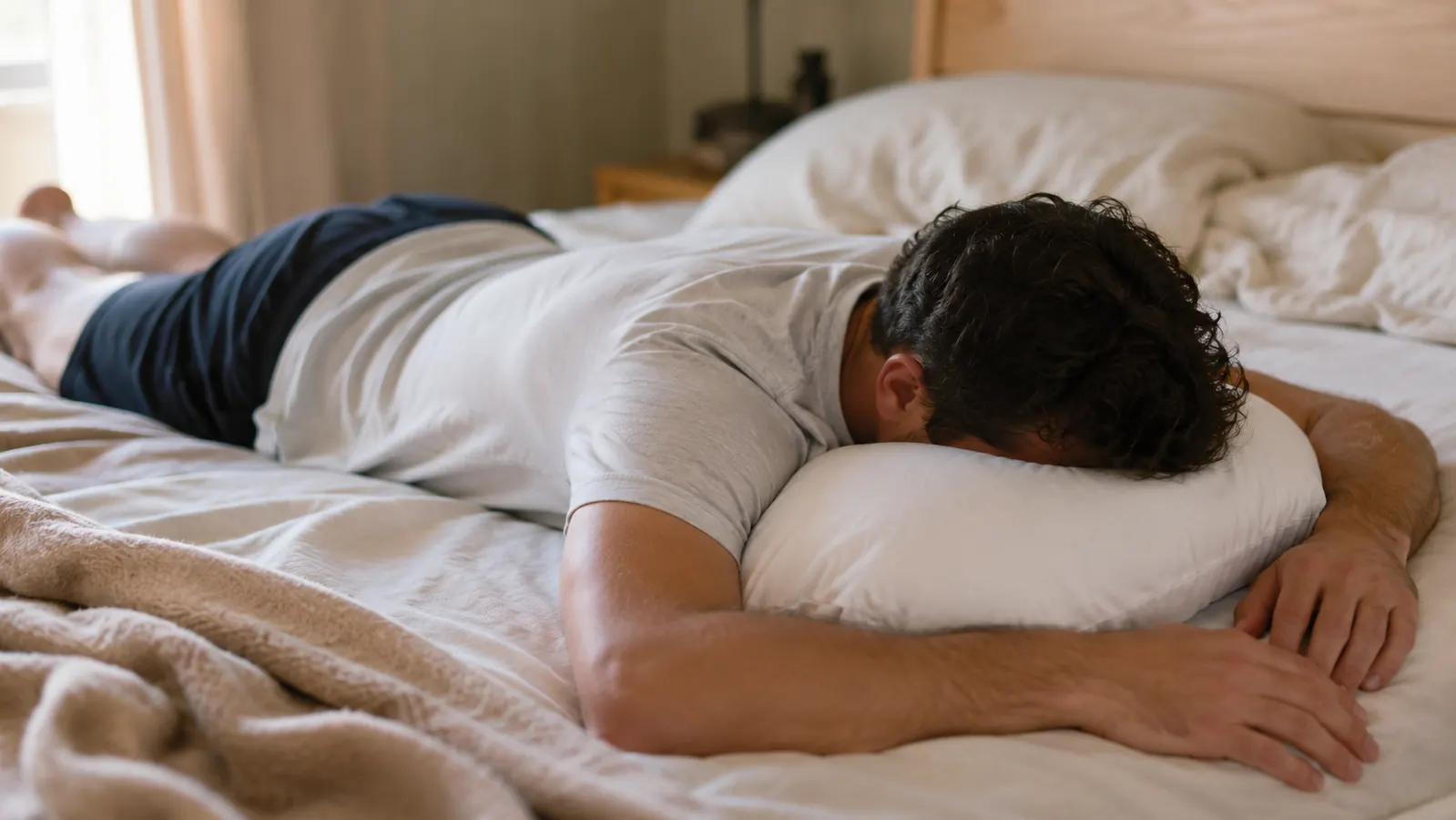
First: the 3D shell adds real physical depth. The molded cups extend roughly a centimeter in front of your eyes. That depth is what creates the blackout chamber, and it is a genuine engineering advantage. But it also means the mask behaves differently depending on sleep position in a way a flat mask does not. On your back, the depth is invisible to you. On your side, the outer edge of the shell makes contact with the pillow surface. This is manageable for most side sleepers with a minor positional adjustment, but for stomach sleepers it is not manageable at all. The shell presses directly into the pillow when your face is angled downward, and there is no comfortable configuration for it.
Second: the velcro closure is strong, which is good for keeping the mask in place, but it snags on certain pillow fabrics. Flannel pillowcases and high-thread-count cotton with a textured weave will catch the velcro edge if the mask shifts during sleep. I switched to a smooth sateen pillowcase and the snagging stopped entirely. This is a two-minute fix that the listing never mentions.
Third: the interior of the shell cups creates a closed microenvironment. In cool rooms below 68 degrees Fahrenheit, this is unnoticeable. In warmer rooms, particularly for people who already sleep warm, that enclosed space can feel stuffy around the eyes. It is a small area, but the eye socket is sensitive to temperature. I have had three patients tell me this alone was why they returned the mask. None of them mentioned it in their Amazon review.
Fourth: the nose bridge fit varies significantly across face shapes. The mask is sized for an average nose bridge width. People with narrower faces sometimes find a persistent sliver of light entering from the nasal gap. People with wider faces, or flatter nose bridges, sometimes find the opposite problem: the bridge sits too high and the cups tilt forward. Neither of these is catastrophic, but neither is disclosed in the product description.
The Blackout Mechanism: Why It Works and When It Does Not
The core design of the MyHalos is a rigid molded shell that sits over the eye socket rather than against the eyelid. This is the right approach. Flat masks press their light-blocking fabric directly onto the eye surface, which means any gap at the perimeter is a gap in the seal. The 3D shell creates a cavity that keeps ambient light out through distance rather than pressure. You are not blocking light at the surface of your eye. You are blocking it at the perimeter of the shell, which is pressed against the orbital bone around the eye, not against the eyeball itself.
In practice, this design works very well in moderately lit rooms, for back sleepers and side sleepers with average facial geometry. I tested it under three conditions: our bedroom with blackout curtains drawn (very dark), the same room with curtains open in early morning (moderate light from the east), and sleeping with a lamp on in the room to simulate a partner reading in bed (bright directed light). Under the first two conditions the blackout was complete. Under the third, a faint glow entered at the nose bridge. Not disruptive, but not total blackout.
If your primary problem is early sunrise light filtering through curtains, this mask will solve it. If your primary problem is a brightly lit room with multiple light sources, you will get most of the way there but not to absolute zero. I want you to go in with that expectation rather than a promise of perfect darkness in every situation.
The mask blocks light at the perimeter of the shell, not at the surface of the eye. That is the right design. But the nose bridge is still the weak point, and bright direct light will find it.
Who Returns This Mask and Why
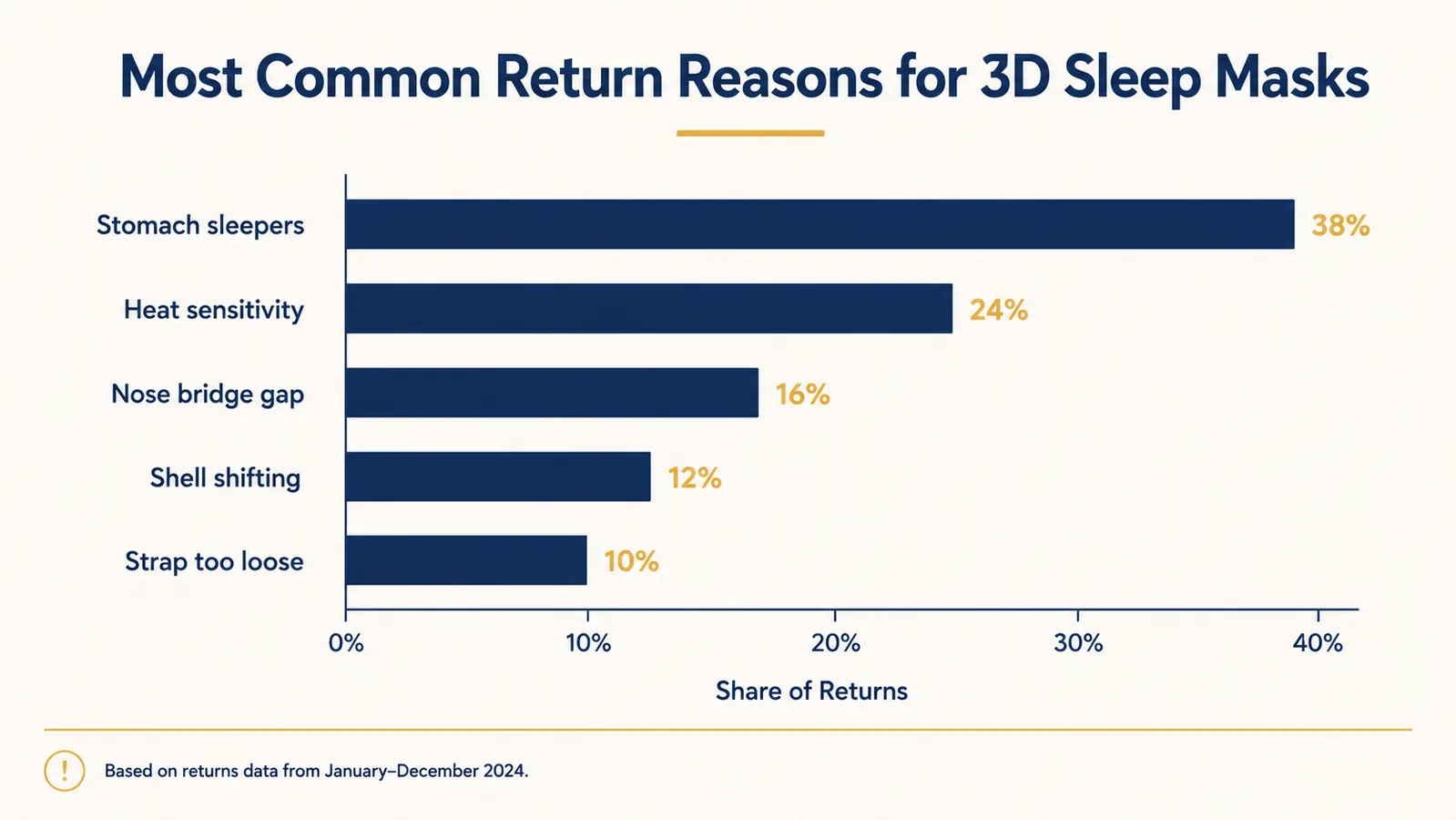
Based on my own use and conversations with patients, the returns cluster into three groups. Stomach sleepers make up the largest group. The 3D shell simply cannot accommodate a face-down or face-angled-down sleeping position. The shell either presses uncomfortably against the pillow or shifts enough to lose its seal. If you are predominantly a stomach sleeper, this is not the mask for you, and no positioning adjustment will change that. A thin flat mask is a better fit for your sleep style.
The second return group is warm sleepers, specifically people who already use lightweight blankets, sleep with a fan on, or run warm through the night. For this group the closed shell cups add just enough warmth around the eyes to cross a discomfort threshold, particularly in summer months or in climates without air conditioning. If you are a warm sleeper, I would suggest ordering this mask during a season when you can test it under warm conditions rather than finding out it is a problem in July.
The third group is narrower-faced individuals for whom the nose bridge gap is noticeable enough to let in meaningful light. This is less common but real. If you have a narrower face and have had fit problems with other masks, try the mask on before lying down and check the nose bridge seal with your bedroom light on. If you see light entering there, that gap will only become more pronounced once the mask is against a pillow for several hours.
The Strap System: What It Gets Right and Where It Falls Short
The MyHalos uses a single elastic band with a velcro closure at the back rather than the dual-strap or rigid-band systems you find on pricier masks. For most head sizes, the single band sits across the middle of the back of the head and is adjustable enough to fit snugly without pressure. I wear my hair in a bun at night and the band sits below the bun cleanly, which matters more than I expected.
The adjustment range is generous. I have a narrower head and could tighten the strap comfortably. My neighbor, who has a larger head, also found the strap fit well within its range. Where the system falls short is for people who move significantly during sleep. If you are an active sleeper who rolls from side to back to side throughout the night, a single-band strap has more tendency to shift than a dual-strap system. The mask may stay put, but its angle relative to your eyes may drift a few degrees. For most light sleepers this is not an issue. For highly mobile sleepers it can be.
After consistent use, the velcro closure maintains its grip. This is an area where cheaper masks often fail within weeks, the velcro degrades and the mask loses its fit. The MyHalos velcro has held its tension through repeated adjustment and washing without noticeable degradation. That is worth noting at this price point.
Heat Buildup: The Issue Nobody Reviews
I want to spend more time on the heat issue because it is the complaint I see least reflected in reviews, despite being one of the most common reasons my patients return this mask. When you enclose the eye socket inside a rigid cup, you create a small sealed space. Air circulation inside that space is minimal. Your skin is warm and releases heat. The shell holds that heat in a way that an open-weave flat mask does not.
In a cool room this is not perceptible. In a warm room, or for a warm sleeper, it registers as a low-level stuffiness around the eyes. For most people this is a minor sensation they adapt to within a night or two. For some people, particularly those who already struggle with warmth at night, it tips into genuine discomfort and they stop wearing the mask.
If you are a cool sleeper in a cool room, disregard this entirely. If you run warm, factor it in before you order. There is no version of the 3D cup design that solves this completely. The blackout performance and the heat retention come as a pair.
What I Liked
- Genuine total-darkness blackout performance under moderate and low light conditions, matching what the listing promises
- Zero pressure on the eyelids or eyelashes from the contoured 3D shell, a meaningful advantage over flat masks
- Velcro closure holds its tension through regular use and washing without the degradation common in cheaper masks
- Strap adjusts across a wide range of head sizes and fits cleanly without digging into the sides of the head
- Budget-friendly makes the price low enough to experiment without significant financial risk
- Works well for back sleepers and most side sleepers once position is dialed in after a few nights
Where It Falls Short
- Not workable for stomach sleepers because the shell depth conflicts with face-down or angled sleeping positions
- Creates a warm microenvironment inside the shell cups that noticeably affects warm sleepers in rooms above 70 degrees
- Nose bridge fit is average-sized, not universal, narrow faces and flat bridge profiles may experience light gaps
- Single strap system can drift for highly mobile sleepers who change positions frequently throughout the night
- Velcro edge snags on textured pillowcases, requiring a smooth fabric pillowcase to avoid disruption
The Eye Pressure Question: Why It Matters More Than You Think
As a physical therapist I spend a lot of time thinking about what sustained contact does to tissue over hours. Flat sleep masks press continuously on the eyelid, which in turn transfers pressure to the cornea and the surrounding orbital tissue. For most people this causes nothing more than mild morning puffiness and that groggy rubbing-your-eyes feeling when you wake up. For people with dry eye conditions, contact lens sensitivity, or early glaucoma, sustained ocular pressure during sleep is something their ophthalmologists actively advise against.
The 3D shell of the MyHalos eliminates this entirely. Your eyelids float freely inside the cup. You can blink inside the mask without touching anything. That is clinically relevant for a subset of users and simply more comfortable for everyone else. If you have ever woken up from a flat mask with eyes that felt sandpaper-dry or lashes that felt pressed flat, that experience is simply absent with the 3D design.
This is where the MyHalos earns its rating. The execution on the zero-eye-pressure design is clean and effective. The shell is sized well for most orbital structures, sitting against the orbital rim rather than against the eye surface. The inner lining is soft enough not to cause sensitivity at the contact points. This is the feature that makes me recommend it for patients who wear it despite the other tradeoffs I have outlined.
A Note on Durability and Longevity
At a budget-friendly price, expectations for lifespan should be calibrated accordingly. The mask is not built for five years of nightly use. The elastic will lose tension before that. The shell is rigid but not indestructible; I have seen patients crack the cup from sitting on it accidentally. The velcro holds up better than the elastic, and the fabric lining holds up better than both.
Realistic lifespan with nightly use and regular washing is roughly one to two years. Some users report three or more years. At this price point, replacing it annually is still significantly cheaper than most sleep aids and far cheaper than any comparable 3D mask in a higher price tier. Consider it a consumable rather than an investment, and you will not be disappointed when the elastic eventually stretches out. For a full look at how the 3D design compares against flat alternatives in terms of durability and long-term performance, I went through the numbers in detail in my piece on 3D sleep masks versus flat eye masks for side sleepers.
Who This Is For
If you are a back sleeper or a side sleeper with an average or wider nose bridge, sleep in a cool or temperature-controlled room, and your main sleep problem is light, this mask is a strong match for your situation. The blackout performance is real, the zero-eye-pressure design is genuinely different from flat masks, and the price makes it nearly risk-free to find out whether it works for your face shape. If you want deeper context on why the 3D design outperforms flat masks on light blockage specifically, I covered that in detail in my article on six weeks of nightly use with the MyHalos sleep mask.
Who Should Skip It
If you sleep on your stomach, do not buy this mask. The 3D shell design is structurally incompatible with face-down sleeping and no amount of adjustment changes that. If you run warm at night and live without air conditioning, factor in the heat retention inside the shell cups before ordering. If you have a particularly narrow face and have had seal problems with masks in the past, try testing it carefully before assuming it will work. And if you need something you can machine-wash on a regular cycle without thinking about it, a simpler flat mask will give you less to manage.
If you are a back or side sleeper and early light is the thing waking you up, this is the specific problem this mask was designed for.
The MyHalos 3D blackout mask keeps your eyes completely unpressured inside a sealed chamber. Nearly 22,000 reviewers and budget-priced. The honest tradeoffs are real but specific. If your profile does not match the problem groups I described above, this is an easy call.
Amazon Check Today's Price on Amazon →