

If you wake up stiff three mornings out of five, you are not sleeping wrong. You are sleeping on the wrong surface. I have worked as a physical therapist for eleven years, and the pattern I see most is this: someone rolls out of bed, massages the base of their skull, and chalks it up to stress or getting older. They try a different sleep position for a week, maybe add another pillow, and when nothing changes they book an appointment with me. By the time they arrive, the problem has been going on for months. The fix, in almost every case, started at the pillow.
This is a five-step plan I give to patients dealing with recurring morning neck pain. It covers sleep position, cervical pillow choice, a short stretch sequence, a few daytime habits nobody thinks to mention, and what to expect in the first two weeks. Follow all five steps and most people notice a real difference within ten days. Skip step three, and the other four will only get you halfway there.
Still reaching for ibuprofen every morning? A cervical pillow might fix what your flat pillow never could.
The Osteo Cervical Pillow is a contoured memory foam neck pillow with a hollow center that keeps your cervical spine in neutral alignment all night. It has over 20,000 reviews on Amazon and a 4.3-star rating. If you want to see what it looks like and check today's price, the link is below.
Amazon Check Today's Price on Amazon →Step 1: Understand Why Your Neck Hurts in the Morning
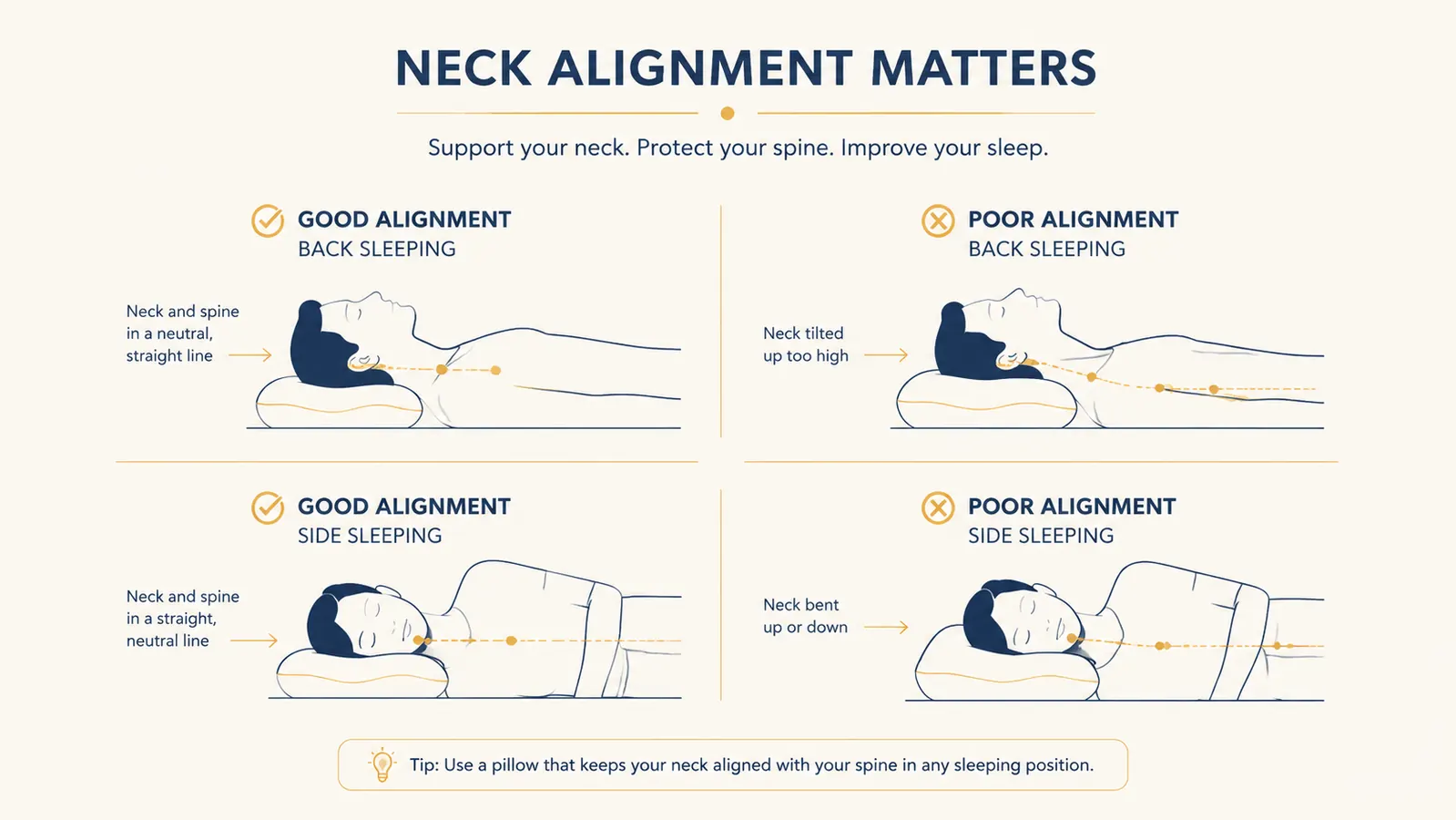
Morning neck pain is almost always a positioning problem, not a sleep depth problem. During the night, your head weighs ten to twelve pounds. A flat pillow that compresses even a few inches puts your neck into lateral flexion or extension for six to eight hours straight. Muscle groups that hold your cervical spine upright during the day are forced to work passively all night in a shortened or lengthened state. You wake up with that tight, restricted feeling along the base of your skull and into the upper trapezius.
The cervical spine has a natural curve, a gentle forward arc called lordosis. A flat pillow pushes that curve into flexion or eliminates it entirely. A pillow that is too high does the same thing from the other direction. What you need is a surface that holds your head so the ear, shoulder, and hip line up in a straight horizontal plane. That is neutral. That is where the muscles can finally rest.
Before you change anything else, identify your primary sleep position. Back sleepers need a pillow with a lower center lobe and support under the neck curve. Side sleepers need more height to bridge the gap between the head and the mattress. Stomach sleepers are in a different category and I will address that in step two. Knowing your position shapes every other decision in this plan.
Step 2: Fix Your Sleep Position Before You Fix Your Pillow
Position comes before equipment. A great cervical pillow used in the wrong position still fails. Back sleeping and side sleeping both support neutral spinal alignment when done correctly. Stomach sleeping is the one position I ask patients to move away from entirely, because it requires the neck to rotate fully to one side for hours at a stretch. That sustained rotation compresses the facet joints on one side and stretches the muscles and ligaments on the other. If you are a stomach sleeper and your neck hurts every morning, this is why.
Transitioning away from stomach sleeping takes two to four weeks for most people. A useful trick is to place a body pillow along your torso so rolling onto your stomach is physically awkward. Your brain retrains the habit faster than you expect. In the meantime, if you cannot avoid it, at least use a very thin pillow or no pillow at all to reduce rotation.
For side sleepers, keep your knees slightly bent and stack them evenly to prevent the pelvis from rotating, which pulls the lumbar and eventually the cervical spine out of alignment as well. For back sleepers, avoid very thick pillows behind the knees, which can tilt the pelvis and increase cervical tension through a chain reaction up the spine. Small adjustments in overall body position reduce the load the neck has to manage all night.
Step 3: Switch to a Cervical Pillow That Holds Neutral Alignment
This is the step most people skip because they assume a new pillow is just a marketing gimmick. It is not, when the design is right. A standard flat pillow has no structural memory. It compresses under your head and leaves your neck unsupported in the space between head and mattress. A cervical pillow is shaped specifically to fill that space. The contour raises the edges slightly for side sleepers and cradles the lower center for back sleepers.
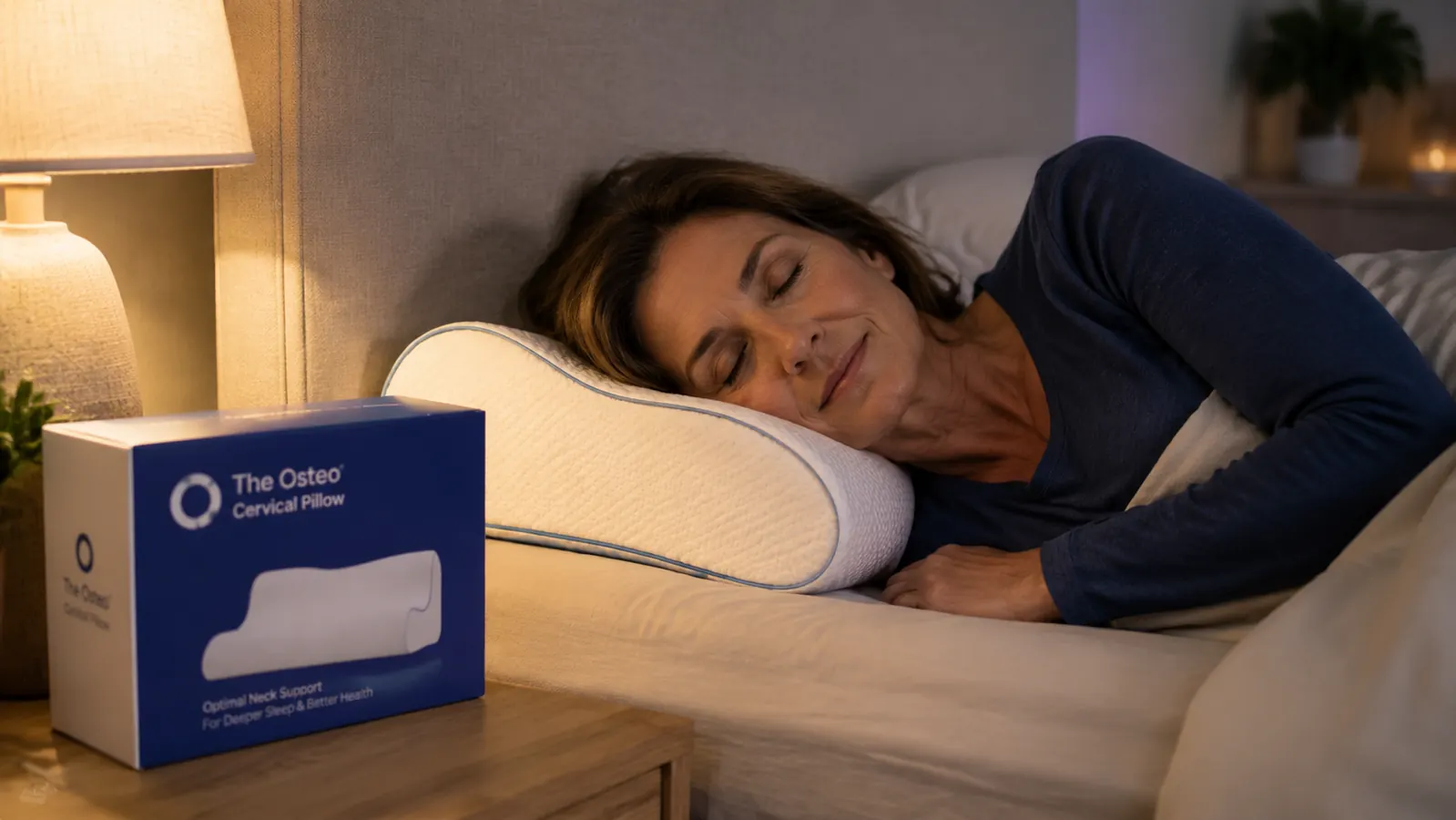
The cervical pillow I recommend most often for my patients is the Osteo Cervical Pillow. It uses memory foam with a hollow center core that reduces pressure at the back of the skull, which helps the suboccipital muscles relax. The contoured shape has a higher lobe and a lower lobe so you can orient it based on your sleep position and your frame. It is odorless, which matters because some memory foam off-gasses significantly for weeks. The Osteo does not do that in my experience.
The break-in period with any cervical pillow is real. Your neck muscles have likely adapted to years of sleeping in a slightly off-neutral position. When you correct that alignment, the muscles need a few nights to recalibrate. Most people feel a mild stiffness in a slightly different location during the first week. That is normal. By night eight or nine, the morning stiffness that sent you looking for a solution typically starts to fade. If it does not, reassess whether the pillow height is correct for your frame.

Pillow height matters more than most people realize. A small-framed person with narrow shoulders sleeping on their side needs less height than a broad-shouldered person. If your head tilts downward toward the mattress on the pillow you chose, it is too low. If your head tilts upward, it is too high. The Osteo Cervical Pillow has enough loft variation built into the contour that it works across a fairly wide range of body types, but pay attention to how your neck feels after the first two nights and adjust accordingly.
I have seen patients spend hundreds of dollars on massage and chiropractic care for morning neck stiffness that went away in two weeks once they replaced their flat pillow with a proper cervical pillow. The pillow is the starting point, not the afterthought.
Step 4: Add a 3-Minute Stretch Sequence Every Morning Before You Stand Up
Do not check your phone first thing. Do not stand up immediately. Spend three minutes in bed running through a short sequence that reintroduces controlled movement to the neck after hours of static load. This sequence is not about working out the kinks. It is about resetting the proprioceptive signals in the cervical joints before you start asking them to hold your head upright under gravity for the next sixteen hours.
Start flat on your back. Do a chin tuck: gently draw your chin straight back toward the pillow without tilting your head. Hold for five seconds, release. Do ten repetitions. This activates the deep cervical flexors, the small muscles that stabilize the vertebrae, and begins restoring the natural cervical curve. Next, slowly rotate your head to the right until you feel a gentle stretch, hold three seconds, then to the left. Do five rotations each side. Finish with gentle lateral tilts, ear toward shoulder, not shoulder toward ear, five each side.
Total time: about three minutes. You do not need a yoga mat. You do not need to get out of bed. The sequence works because it addresses the muscular consequences of hours in one position before you add the load of standing and moving. Patients who add this sequence report that even mornings when their neck is still slightly sore, the stiffness resolves about sixty percent faster than before.

Step 5: Address Two Daytime Habits That Make Nighttime Neck Pain Worse
Neck pain that starts at night often has daytime accelerants nobody connects to their morning symptoms. The two biggest ones I see in clinic are forward head posture during screen time and shoulder carrying while stressed. Both create sustained muscle tension that does not release by bedtime. You lie down with already-tense suboccipital and upper trapezius muscles, and the pillow situation simply makes it worse.
Forward head posture adds roughly ten pounds of effective load to the cervical spine for every inch the head moves forward from neutral. At a desk, most people sit with the head four to five inches forward. That translates to an extra forty to fifty pounds of load on the muscles and joints of the neck. An ergonomic monitor position, screen at eye level and about an arm's length away, reduces that load dramatically. If you work from a laptop, a separate keyboard and an elevated stand are worth the cost.
Stress-related shoulder carrying is subtler. When people are tense, they shrug their shoulders slightly and hold them there for hours. This chronically contracts the levator scapulae and upper trapezius, exactly the muscles that connect to the cervical spine. A conscious habit of dropping your shoulders and taking one slow breath through the nose every thirty minutes during a stressful workday makes a measurable difference in how the neck feels at bedtime. These two daytime changes, combined with the cervical pillow and the morning stretch, close out the full picture.
What Else Helps With Morning Neck Pain
Beyond the five steps, a few supporting changes speed up recovery. Mattress firmness matters because a mattress that sags in the middle changes body position throughout the night regardless of what your pillow does. If your mattress is more than eight years old and you sleep in a body impression, that is worth investigating separately. A mattress topper can sometimes bridge the gap without replacing the whole mattress.
Hydration affects intervertebral disc health. The discs in your cervical spine are mostly water. Chronic mild dehydration reduces their ability to absorb load and maintain height, which increases pressure on the facet joints during the night. Drinking enough water during the day, not just in the evening, is a legitimate low-cost intervention for neck discomfort. It does not replace the pillow work, but it supports it.
If morning neck pain is accompanied by tingling, numbness, or weakness in the arms or hands, stop here and see a healthcare provider before trying self-treatment. Cervicogenic symptoms that radiate into the upper limbs can indicate nerve root irritation or disc pathology that needs clinical assessment. The steps above are appropriate for mechanical morning stiffness. They are not a substitute for evaluation of referred symptoms.
For more detail on the cervical pillow itself, including how it compares to a standard flat pillow and what the break-in period actually looks like over eight weeks, see my full review at Osteo Cervical Pillow Review: 8 Weeks of Sleeping on It Every Night. If you are still deciding between a cervical design and your current pillow, the side-by-side comparison at Osteo Cervical Pillow vs Regular Pillow covers the structural differences in plain terms.
You have tried adjusting your position and it helped for a night. The cervical pillow is what makes the fix stick.
The Osteo Cervical Pillow is the specific product I recommend to patients who wake up with recurring neck stiffness. The contoured memory foam holds neutral cervical alignment so your muscles can actually rest instead of compensating all night. Over 20,000 Amazon customers. Click below to check today's price and see the current reviews.
Amazon Check Today's Price on Amazon →